


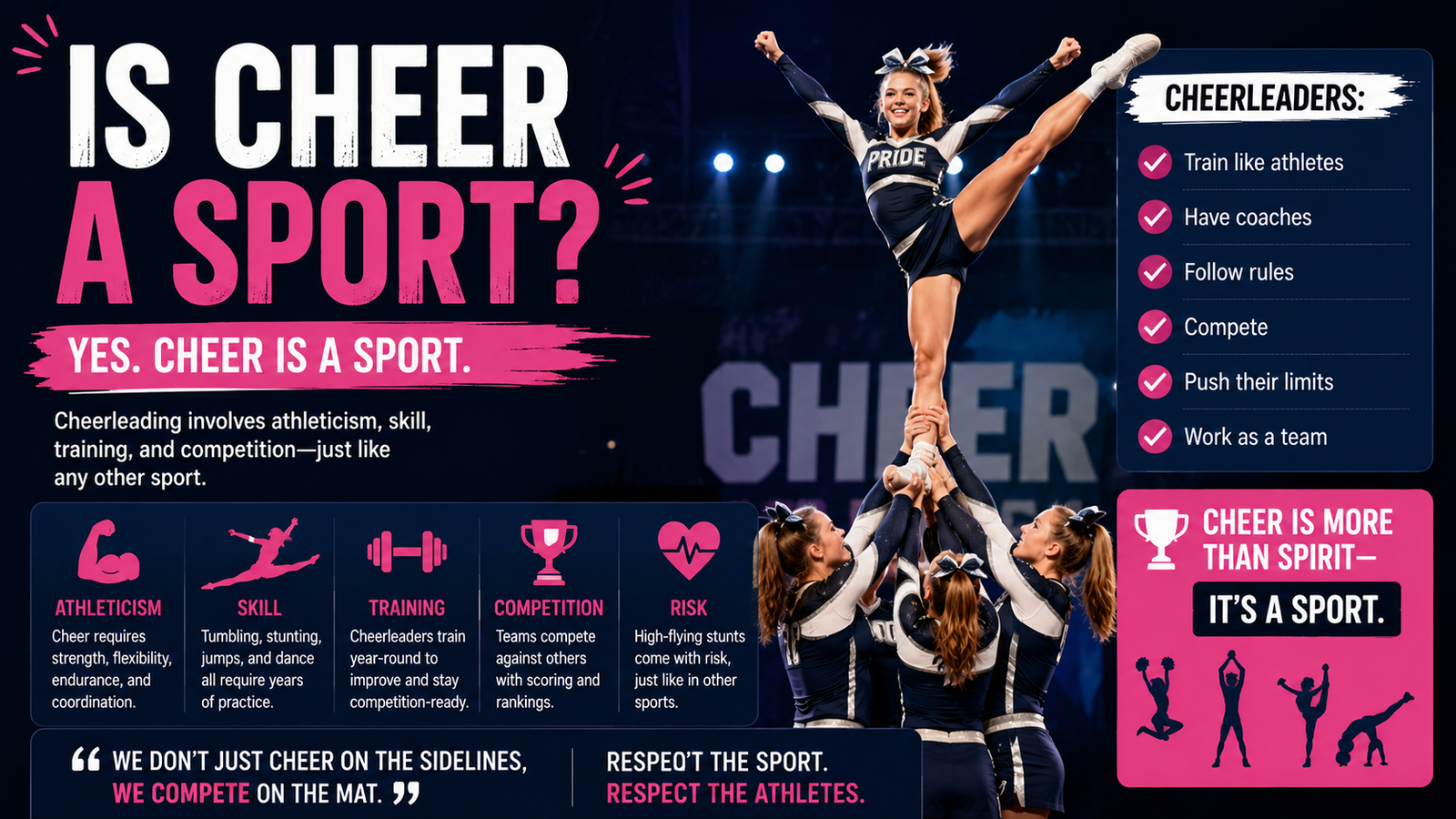
For many years, people have debated one question over and over again: Is cheer a sport? Some people immediately say yes because they see the athleticism involved, while others believe cheerleading is simply a sideline activity meant to support other sports teams. The truth is a lot more complicated than a simple yes or no answer.
Modern cheerleading has evolved dramatically from what it used to be decades ago. Today, cheer athletes perform complex routines that involve tumbling, stunts, jumps, dance movements, and incredible teamwork. The physical demands are intense, and participants often train just as hard as athletes in traditional sports.
In this article, we’ll explore whether cheer is officially considered a sport, why there is still debate surrounding it, and what makes modern cheerleading one of the most demanding athletic activities in the world.
What Exactly Is Cheerleading?
Cheerleading originally began as a way to energize crowds and support school sports teams. The primary role of cheerleaders was to lead chants, encourage fans, and create excitement during games. Over time, however, cheerleading transformed into something much bigger.
Today, there are several forms of cheerleading. Sideline cheerleaders still perform during football and basketball games, but competitive cheerleading has become its own discipline. Competitive teams participate in regional, national, and international competitions where they are judged based on difficulty, synchronization, execution, and overall performance.
Modern cheer routines include advanced gymnastic skills, pyramid formations, basket tosses, tumbling passes, and choreographed dance sequences. These routines require athletes to develop strength, flexibility, endurance, and precision. Because of these elements, many experts argue that cheer absolutely meets the requirements of a sport.
Why Is There a Debate About Whether Cheer Is a Sport?
The biggest reason for the debate is cheerleading’s history. Since cheerleading started as a support activity rather than an independent competition, many people still associate it with entertaining crowds instead of athletic competition.
Another reason is that not all forms of cheerleading are the same. Sideline cheer and competitive cheer have different objectives. Sideline cheer primarily focuses on supporting other teams, while competitive cheer is centered entirely around athletic performance and competition.
There have also been legal and organizational disagreements over the years. Different schools, athletic associations, and governing bodies have varying definitions of what officially qualifies as a sport. This inconsistency has created confusion among students, parents, and sports enthusiasts.
Some critics argue that a sport must have standardized rules and a single governing body. Although cheerleading has organizations that regulate competitions, global standardization is still developing compared to sports like soccer, basketball, or swimming.
What Qualifies an Activity as a Sport?
Before answering whether cheer is a sport, it’s important to understand what defines a sport in the first place.
Most experts agree that a sport generally includes physical exertion, skill development, competition, structured rules, and organized participation. When we apply these criteria to cheerleading, many boxes are checked immediately.
Cheerleading requires exceptional physical effort. Athletes spend countless hours practicing stunts, building strength, and improving flexibility. Their training schedules can be extremely demanding and often include conditioning exercises similar to those used in gymnastics.
Competition is another major factor. Competitive cheer teams participate in tournaments where judges score performances according to established guidelines. Teams compete against each other to achieve the highest scores, making competition a central element of the activity.
Finally, cheerleading requires specialized skills. Athletes must master techniques that take years to develop, including tumbling, balancing, lifting, timing, and coordination.
The Physical Demands of Cheerleading
Anyone who has watched a competitive cheer routine knows that it is far from easy. Cheer athletes push their bodies to incredible limits.
Strength is one of the most important components. Bases must safely lift and support flyers in complex stunts, while flyers need strong core muscles to maintain balance high above the ground. Every member of the team plays a critical role.
Endurance is equally important. Competitive routines are typically short but extremely intense. Athletes perform high-energy movements without stopping while maintaining perfect synchronization and smiling throughout the entire performance.
Flexibility also plays a huge role. Cheerleaders practice splits, jumps, backbends, and various body positions that require months or even years of dedicated training. Without proper flexibility, executing advanced skills would be nearly impossible.
Mental toughness is another requirement. Athletes must remain focused under pressure because even a small mistake can affect an entire routine and potentially cause injuries.
Is Competitive Cheer Different From Traditional Cheer?
Yes, and this distinction is one of the biggest reasons for the ongoing debate.
Traditional sideline cheerleaders perform at school sporting events to motivate crowds and support their teams. While this still requires athletic ability, competition is not always the primary focus.
Competitive cheerleading, however, operates much more like traditional sports. Teams spend months preparing routines specifically for competitions. They are judged based on technical execution, creativity, difficulty, and synchronization.
Competitive cheer athletes often train several times a week, sometimes for multiple hours per session. Their commitment can easily match or exceed that of athletes in other sports.
Because of these differences, many experts believe that competitive cheer should unquestionably be classified as a sport, while sideline cheer may be viewed differently depending on the organization.
What Do Official Organizations Say?
The answer varies depending on the country and governing body.
In the United States, the status of cheerleading has changed over time. Some organizations recognize competitive cheer as a sport, while others classify it as an athletic activity.
The International Olympic Committee took a major step by granting recognition to the international governing body for cheerleading. This recognition helped strengthen the argument that cheer is a legitimate sport on a global level.
Schools and universities also have different policies. Some include cheer within their athletic departments, while others treat it as an extracurricular activity.
As cheerleading continues to evolve and gain international popularity, official recognition is becoming more widespread.
The Risks and Injuries Associated With Cheerleading
One aspect people often overlook is the risk involved in cheerleading.
Cheerleading can be dangerous because athletes perform high-level stunts and aerial movements. Falls, collisions, and improper landings can result in injuries if safety measures are not followed.
Studies have shown that cheerleading accounts for a significant number of severe injuries among school athletes, particularly when advanced stunts are involved. This fact alone highlights how physically demanding the activity truly is.
Fortunately, safety standards have improved over the years. Coaches receive specialized training, athletes use protective equipment, and organizations have implemented stricter rules to reduce risks.
Even with these improvements, cheerleading remains an activity that requires discipline, preparation, and proper supervision.
So, Is Cheer a Sport?
For many experts, the answer is yes—especially when referring to competitive cheerleading.
Cheer meets most of the widely accepted criteria used to define a sport. It requires physical exertion, advanced skills, organized competition, teamwork, and extensive training.
The confusion largely comes from cheerleading’s historical role as a support activity rather than an independent competition. However, modern competitive cheer has evolved far beyond its original purpose.
While some organizations may still debate its official classification, there is no denying the athletic ability required to participate at a high level.
At the end of the day, anyone who has witnessed a competitive cheer routine can see the immense strength, dedication, and talent involved. Whether everyone agrees on the label or not, cheer athletes deserve recognition for the hard work they put into their craft.
Final Thoughts
The debate over whether cheer is a sport will probably continue for years, but one thing is certain: cheerleading has transformed into a highly demanding athletic activity.
Today’s cheer athletes are strong, disciplined, and incredibly skilled. They train rigorously, compete under pressure, and perform complex routines that require both physical and mental excellence.
As the sport continues to gain international recognition, more people are beginning to appreciate just how challenging cheerleading truly is.
So, the next time someone asks, “Is cheer a sport?” the evidence strongly suggests that modern competitive cheer deserves a place alongside other recognized sports.
You May Also Read: Schoology Games


