


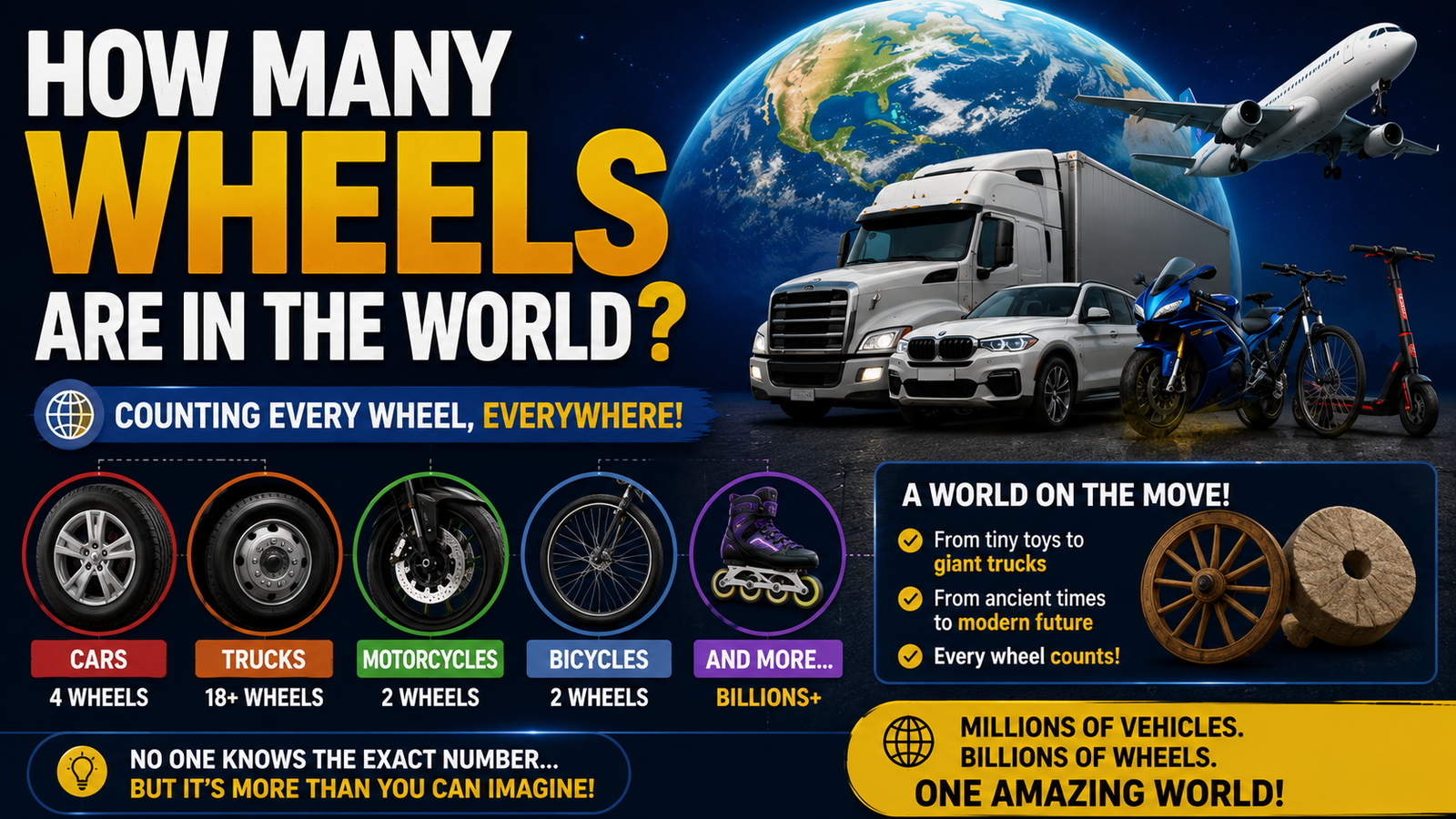
Have you ever looked around and wondered how many wheels are in the world? It sounds like a simple question, but the answer is far more interesting than you might expect. Wheels are everywhere—from cars and bicycles to office chairs, shopping carts, suitcases, toys, and factory equipment.
While no organization tracks the exact number of wheels worldwide, we can make a well-informed estimate by looking at the billions of vehicles, machines, and everyday products that use them. In fact, many experts believe there are well over 100 billion wheels across the globe, and the real number could be much higher.
In this article, we’ll explore where all these wheels come from, estimate how many exist, compare wheels with other common objects, and explain why this seemingly simple question has become such a fascinating topic.
What Is a Wheel?
A wheel is a circular object designed to rotate around an axle, making it easier to move people, goods, or machinery. It is considered one of humanity’s greatest inventions because it transformed transportation, manufacturing, and daily life.
Today, wheels come in countless sizes and designs. Some are built to carry heavy trucks, while others help office chairs glide across a room. Even tiny toy cars have miniature wheels that count toward the global total.
Modern wheels are made from materials such as rubber, steel, aluminum, plastic, and polyurethane, depending on their purpose.
Why Is It So Difficult to Count All the Wheels?
Unlike counting the world’s population or registered vehicles, there is no official database that records every wheel ever manufactured.
Several factors make the estimate challenging:
- New wheels are produced every day.
- Old wheels are recycled or discarded.
- Many products contain hidden wheels.
- Billions of toys and industrial machines are never officially counted.
- Wheels exist in homes, businesses, warehouses, factories, airports, hospitals, and farms.
Because of these factors, any answer is an estimate rather than an exact figure.
Estimated Number of Wheels Around the World
Let’s estimate the number by looking at the biggest contributors.
Cars
There are approximately 1.5 billion cars worldwide.
Most cars have:
- 4 road wheels
- 1 spare wheel (sometimes)
- Steering wheels (not counted since they aren’t used for movement)
Assuming an average of four road wheels:
1.5 billion × 4 = 6 billion wheels
Motorcycles
There are roughly 700 million motorcycles and scooters globally.
Each has two wheels.
Estimated total:
700 million × 2 = 1.4 billion wheels
Bicycles
Bicycles may surprise you.
Experts estimate there are over 2 billion bicycles worldwide.
Each bicycle has two wheels.
Estimated total:
2 billion × 2 = 4 billion wheels
Trucks and Commercial Vehicles
Commercial transport includes:
- Delivery vans
- Semi-trucks
- Construction vehicles
- Buses
Many large trucks have between 6 and 18 wheels.
Estimated contribution:
5–8 billion wheels
Airplanes
Commercial aircraft use far more wheels than most people realize.
For example:
- Small planes may have 3 wheels.
- Boeing 747 aircraft have 18 wheels.
- Airbus A380 aircraft have 22 wheels.
Although there are only thousands of airplanes compared to billions of cars, they still contribute hundreds of thousands of wheels.
Trains
Passenger trains and freight trains contain enormous numbers of wheels.
A single freight train can have over 400 wheels, depending on its length.
Worldwide, trains contribute millions of wheels.
Industrial Machinery
Factories, warehouses, hospitals, and airports rely on wheeled equipment, including:
- Conveyor systems
- Pallet jacks
- Medical carts
- Tool trolleys
- Warehouse robots
These account for billions more wheels globally.
Everyday Household Items
This is where the numbers become surprisingly large.
Many everyday products contain wheels, including:
- Office chairs
- Suitcases
- Baby strollers
- Shopping carts
- Wheelbarrows
- Rolling storage bins
- Vacuum cleaners
- Rolling furniture
A single household may easily contain 30–100 wheels without anyone noticing.
Toys
Toy manufacturers produce enormous numbers of wheeled products every year.
Examples include:
- Toy cars
- LEGO vehicle sets
- Ride-on toys
- Toy trains
- Skateboards
- Scooters
Millions of families own dozens of toy vehicles, making toys one of the biggest contributors to the global wheel count.
Estimated Wheel Count by Category
| Category | Estimated Wheels |
| Cars | 6 billion |
| Motorcycles | 1.4 billion |
| Bicycles | 4 billion |
| Trucks & buses | 5–8 billion |
| Trains | Millions |
| Airplanes | Hundreds of thousands |
| Office furniture | 20+ billion |
| Shopping carts | Hundreds of millions |
| Suitcases | Billions |
| Industrial equipment | 20+ billion |
| Toys | 40–60 billion |
| Estimated Total | 100–150+ billion wheels |
These estimates suggest the world likely contains more than 100 billion wheels, with toys, furniture, and industrial equipment making up a surprisingly large share.
Where Are Most Wheels Found?
Many people assume cars account for most wheels, but that’s probably not true.
Large numbers of wheels exist in:
Homes
Rolling office chairs, toys, suitcases, carts, and furniture add up quickly.
Businesses
Offices use wheeled chairs, filing cabinets, and equipment every day.
Warehouses
Distribution centers use thousands of pallet trucks, carts, forklifts, and conveyor rollers.
Factories
Manufacturing plants rely on countless machines containing rollers and transport wheels.
Schools and Hospitals
Medical carts, classroom furniture, laboratory equipment, and transport trolleys all contribute to the total.
Wheels vs. Doors: Which Are More Common?
One of the internet’s most popular debates asks whether there are more wheels or doors in the world.
Here’s a simple comparison:
| Wheels | Doors |
| Found on toys | Rarely found on toys |
| Office chairs have 5 wheels | Most chairs have no doors |
| Shopping carts have 4 wheels | Shopping carts have no doors |
| Suitcases often have 2–8 wheels | Suitcases have no doors |
| Many machines contain dozens of wheels | Machines often have few or no doors |
Because toys and office furniture are produced in such huge numbers, many analysts believe wheels likely outnumber doors worldwide, although there is no official answer.
Why Wheels Matter More Than We Think
Wheels are essential to modern life.
Without them, everyday tasks would become much harder.
They help us:
- Travel efficiently
- Transport goods
- Move heavy equipment
- Improve workplace productivity
- Reduce physical effort
- Support global trade
From hospitals to airports, wheels keep industries moving around the clock.
Interesting Facts About Wheels
- The wheel was invented more than 5,000 years ago.
- Modern cars usually have four wheels, but some vehicles have six, eight, or even more.
- Office chairs often have five caster wheels.
- A large mining truck can use wheels taller than an average adult.
- Some factory conveyor systems contain thousands of rollers that function as wheels.
Practical Tips to Make Your Wheels Last Longer
Whether it’s your car, office chair, or suitcase, proper care can extend the life of your wheels.
Keep Them Clean
Remove dirt, hair, and debris regularly to reduce wear.
Check for Damage
Look for cracks, flat spots, or loose fittings before they become bigger problems.
Lubricate Moving Parts
Caster wheels and bearings often work better with occasional lubrication.
Replace Worn Wheels Early
Changing damaged wheels improves safety and helps prevent further damage to equipment.
Use the Right Wheel for the Job
Heavy-duty wheels should be used for heavy loads, while lighter wheels are suitable for household items.
Frequently Asked Questions
1. How many wheels are in the world?
No exact number exists, but experts estimate there are between 100 and 150 billion wheels, and the total continues to grow every year.
2. Do toys contribute significantly to the total?
Yes. Toy cars, trains, ride-on toys, and construction sets contain billions of wheels worldwide.
3. Are there more wheels than cars?
Absolutely. Every car has multiple wheels, but billions of other products also use wheels, making the total far higher than the number of vehicles.
4. Are there more wheels or doors in the world?
There is no official answer, but many estimates suggest wheels outnumber doors, mainly because of toys, furniture, industrial equipment, and carts.
5. Why can’t anyone calculate the exact number?
Wheels are constantly being manufactured, recycled, and discarded. Since no global database tracks every wheel, only educated estimates are possible.
Conclusion
So, how many wheels are in the world? While nobody can provide an exact count, the evidence points to an astonishing estimate of more than 100 billion wheels, with some estimates reaching 150 billion or even higher. Beyond cars and bicycles, wheels power countless everyday items—from office chairs and luggage to shopping carts, toys, hospital equipment, and industrial machinery.
The next time you spot a rolling suitcase or push a shopping cart, remember that these everyday objects are part of an incredible global network of wheels that keeps people, products, and businesses moving. If you enjoy uncovering surprising facts and practical insights like this, explore more of our articles to discover the fascinating stories behind the ordinary things we use every day.
You May Also Read: Orion Amphitheater


